

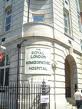
William Morgan MD MRCS MBHS (March 18, 1819 – July 9, 1891) was a British orthodox physician and surgeon who converted to homeopathy to become a member of the British Homeopathic Society, Physician to the Brighton Homeopathic Dispensary, Physician to the North London Homeopathic Dispensary, Medical Officer at the Cambridge Homeopathic Dispensary, founder and Accoucheur of the West End Maternity Institute for Welsh Women, and Medical Officer at the London Homeopathic Hospital.
William Morgan practiced at 14 Tyndale Place, Islington, London in 1868, in Cambridge in 1873, and at 16, Edwards Terrace, Cardiff, where he founded the South Wales Homoeopathic Institution.
William Morgan was born in Glamorganshire, Wales, on March 18, 1819, the sixth of eight children born to clergyman John Evan Morgan (1786 – 1844), curate of St Bridget’s Church in St Brides Major, and his wife Sarah Davies (1784 – 1833).
Morgan began medical training at Charing Cross Hospital Medical School and the Hunterian School of Medicine (formerly the North London School of Medicine) at 20 Charlotte Street, Bloomsbury.
In December 1846, Morgan, then in Bridgend, Wales, passed the examination and was admitted as a member of the Royal College of Surgeons. Morgan subsequently undertook further medical studies at Kings College, University of Aberdeen, from where he qualified M.D. in 1856.
It is unclear when or how Morgan came into contact with homeopathy but by 1853 he had become of a member of the British Homoeopathic Society, his first position was his appointment as physician to the Brighton Homeopathic Dispensary.
By 1854, he was on staff at the London Homoeopathic Hospital where he and his colleagues Robert Baikie, Hugh Cameron, John Hutton Hill, Thomas Robinson Leadam, Frederick Hervey Foster Quin, Daniel Smith, Severin Wielobycki, George Wyld, Stephen Yeldham treated patients during the cholera epidemic.
In 1850, Morgan married Catherine Robinson (1825-1919), daughter of Charles Robinson esq of Demerara, Collector of Customs in British Guiana. They had two daughters, Sarah Louisa Morgan (1851-1940) and Catherine Elizabeth Morgan (1853-).
By 1857, Morgan was in Dover where he established a new Dover Homoeopathic Dispensary at 174 Snargate, also operating a branch dispensary in Folkestone.
Although Morgan had first begun practice at the Brighton Homeopathic Dispensary, more than twenty years later in 1877 he was still listing himself as physician to that particular homeopathic establishment, demonstrating that he continued to maintain dedicated professional ties to the Sussex area.
William Morgan wrote several medical books, most of them from an homeopathic perspective, and contributed to British and overseas homeopathic periodicals such his article “The Liver: Historically, Anatomically, Physiologically and Clinically Considered” and extracts from his case book on toothache.
For the final few years of his life Morgan returned to his native Wales. In 1885, he was listed in the Medical Directory as practicing at 16, Edwards Terrace, Cardiff. It was at that address where, in December 1879, he established the South Wales Homoeopathic Institution. This establishment proved a success, as was demonstrated in its 6th annual report, published in the Homoeopathic World in 1888:
From the founding of this Institution in December 1879 to the close of February 1888 a period of eight years and two months there have been registered 7,770 patients who required 9,403 attendances medicine and surgical appliances besides 3,717 visits at their own homes…
The report also revealed an impressive list of patrons, including:
The Right Hon, the Earl of Dunraven, K.T.; The Right Hon. Lord Tredegar; The Right Hon. Robert George Lord Windsor; Sir George Walker, Bart.; Colonel The Hon, F. C. Morgan, M.P.; John Talbot Dillwyn Llewelyn, Esq., J.P., D.L.; Colonel T. Picton-Turberville, J.P.; Colonel Charles H. Page, J.P.
Patronesses :- The Right Hon. Lady Windsor; The Right Hon. Lady Llanover; The Hon. Lady Walker; The Hon. Mrs. F. C. Morgan; Mrs. Mackintosh, of Mackintosh, Cottrell; Mrs. William Charles Luard.
According to The Homoeopathic World, Morgans health had been gradually declining for about a year before his death in July 1891:
We understand that his health remained quite good until he was in a railway accident, from the effect of which he never really recovered.
He had a large clientèle in Cardiff, by whom he will be greatly missed. He leaves a widow and two daughters.
Sadly, following Morgan’s death the South Wales Homoeopathic Institution closed. An anonymous correspondent who retained Morgan’s books and possessions wrote to The Homoeopathic World that the institution would be a good opening for “a really clever man,” but no homeopath stepped forward to take over in Cardiff.
Select Publications:
- The Homeopathic Treatment of Indigestion, Constipation, and Haemorrhoids (1852)
- Tic Douloureux: Its Causes, Symptoms, and Treatment (1856)
- Diphtheria: Its History, Causes, Symptoms, Diagnosis, Pathology, and Treatment (1860)
- The Philosophy of Homeopathy (1864)
- Contagious Diseases; Their History, Anatomy, Pathology, and Treatment (1877)
- Diabetes Mellitus: Its History, Chemistry, Anatomy, Pathology, Physiology and Treatment (1877)
- The Liver and its Diseases, Both Functional and Organic (1877)
- The Signs and Concomitant Derangements of Pregnancy: Their Pathology and Treatment (1877)
Of interest:
William Isaac Morgan MD [no relation] was an Irish physician who practiced in Dublin, Bath, and later practiced in Plymouth, and was a founder member of the British Institute of Homoeopathy.
A Dr. Morgan was the homeopath in Edward Bulwer Lytton’s 1835 novel Rienzi, the Last of the Tribunes.
Rev E. O. Morgan was on the Management Committee of the Clapham Homeopathic Dispensary,
Samuel Morgan MD MRCS LSA (1832 – 1920) was a Physician at the Bath Homeopathic Hospital & Dispensary, and author of The Text Book for Domestic Practice (1858)
T Morgan (almost certainly a typographical error and probably the above Samuel Morgan) was a Physician for the Caledonian Fire and Life Insurance Company, alongside William Bayes (in Bath).
Major William Vaughan Morgan (1826 – 1892) was a a Welsh chemist and businessman and keen supporter of homeopathy. He served as Treasurer and Chairman of the Management Committee for the London Homoeopathic Hospital.
Leave A Comment